Baby Passport Photo Requirements France 2026
Applying for a French passport for an infant sounds simple. Take a picture. Submit the paperwork. Wait for approval. Done - right?
Not exactly.
French authorities are famously precise about documentation, and in 2026 the baby passport photo requirements France families must follow are stricter than many expect. A slightly open mouth. A shadow behind the head. Eyes not fully visible. Any of these tiny details can trigger a rejection.
If you ask seasoned parents, they will tell you this: the photo is often the hardest part of the entire application.
So let’s break it down clearly, practically, and without fluff.
Why France Is So Strict About Baby Passport Photos
France follows biometric standards designed to improve identification accuracy and prevent fraud. Even newborns must meet specific criteria because the image will be scanned, measured, and compared using facial recognition systems.
Think of it like this - the photo is not just a snapshot. It is data. Structured, measurable, technical data.
That’s why casual smartphone photos taken in poor lighting often fail. The system does not care how cute the child looks. It cares about symmetry, contrast, and facial positioning.
Official Baby Passport Photo Requirements France 2026
Here are the current rules parents must follow in 2026:
1. Photo Size and Format
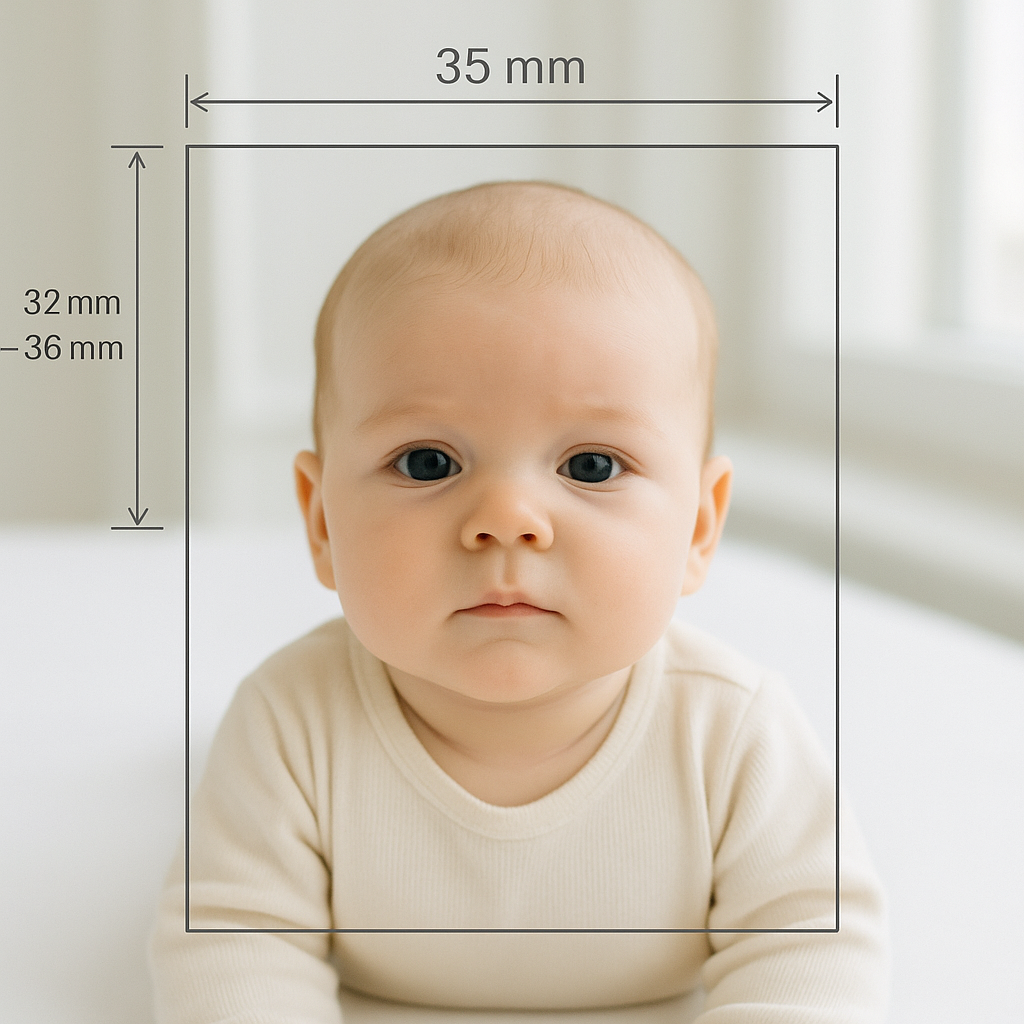
- Size must be 35mm wide x 45mm high
- Head height must measure between 32mm and 36mm
- Face must occupy 70 - 80% of the image
- Printed on high quality photo paper
- No creases, marks, or damage
Sounds technical? It is. Even a few millimeters off can cause rejection.
2. Background Requirements
- Plain, light background - usually white or light grey
- No patterns
- No shadows
- No visible objects
A common mistake is photographing the child against a cream wall that appears white to the eye but prints slightly yellow. Authorities notice.
3. Facial Expression Rules
- Eyes fully open
- Looking directly at the camera
- Mouth closed
- No smiling or exaggerated expressions
Yes - even for infants.
France does allow some flexibility for newborns who cannot fully support their heads. However, the face must still be clearly visible and unobstructed.
4. Head Position and Visibility
- Head centered in the frame
- No tilting
- Both ears preferably visible
- No hands covering the face
- No pacifiers, toys, or accessories
This is where many attempts fail. A tiny hand drifting into frame. A subtle lean to one side. It seems harmless - until it is rejected.
5. Glasses, Hats, and Accessories
- No hats or head coverings (unless for medical reasons)
- No sunglasses
- No tinted lenses
Even decorative headbands can cause issues if they obscure the hairline.
Special Considerations for Newborns
Photographing a newborn is not like photographing a toddler. They cannot sit upright. They cannot follow instructions. They blink at the worst possible moment.
French authorities do allow infants to be photographed lying down. The key requirements still apply:
- No visible parent hands
- No shadows around the head
- Neutral background beneath the child
Many parents lay the baby on a white sheet. It works - if done carefully. Wrinkles in fabric can create shadows that lead to rejection.
Precision matters.
Common Mistakes That Lead to Rejection
Here’s a reality check. Most rejected applications are due to small photo errors. Not paperwork. Not missing forms. Just the image.
The most common issues include:
- Incorrect head size proportion
- Background not truly uniform
- Baby looking slightly off camera
- Visible support hands
- Overexposed lighting washing out facial features
- Shadows behind the head
- Mouth slightly open
Each of these may seem minor. Together, they can delay travel plans by weeks.
DIY vs Professional Passport Photo Services
So what’s better - taking the picture at home or using a professional service?
There are two realistic options:
Option 1 - Traditional Photo Studio
Pros:
- Professional lighting
- Correct sizing guaranteed
- Immediate printed copies
Cons:
- Expensive
- Stressful with infants
- Limited flexibility if child becomes fussy
Option 2 - Online Passport Photo Services
Modern parents increasingly use digital platforms that adjust photos to meet official French standards.
One reliable option is BabyPassportMaker.com. The service automatically resizes, centers, and checks the image to match 2026 biometric requirements.
This approach offers:
- AI background correction
- Compliance verification
- Printable templates formatted to French dimensions
- Convenience from home
Honestly, convenience alone makes it appealing. No car seat juggling. No waiting room stress. Just controlled lighting at home and multiple attempts until it looks right.
Lighting Tips for Perfect Baby Passport Photos
Lighting can make or break the photo. It’s the invisible detail that determines approval.
Follow these guidelines:
- Use natural daylight near a window
- Avoid direct sunlight
- Position light in front of the child, not behind
- Eliminate shadows under the chin
- Turn off overhead lights that create color distortion
Imagine lighting like water filling a glass - it should evenly cover every part of the face without harsh contrast.
What Happens If the Photo Is Rejected?
Rejection means delay. French administrative processes are efficient but procedural. If the image fails validation:
- You must retake the photo
- Resubmit the application
- Wait again for processing
For families planning international travel, that delay can disrupt flights, accommodations, even visas.
Is it worth risking a do-over to save a little effort upfront? That’s the real question.
How Long Is a Baby Passport Valid in France?
As of 2026, French passports issued to minors under 18 remain valid for five years.
However, appearance changes quickly during infancy. Border officials must still be able to recognize the child from the image. That is another reason clarity and proper composition are critical.
Quick Checklist Before Submitting
Before printing or uploading, review this final checklist:
- Correct 35mm x 45mm dimensions
- Head centered and properly sized
- Plain light background
- Eyes open and visible
- No shadows or objects
- High resolution, sharp focus
- No red eye
Double check. Then check again.
Because when it comes to baby passport photo requirements France 2026, details are everything.
Final Thoughts
Getting an infant passport photo approved in France is not complicated - but it is precise. Think of it like assembling a small mechanical watch. Every tiny piece must align perfectly.
Parents who prepare properly, understand official standards, and use compliant tools dramatically reduce the chance of rejection.
Travel should feel exciting. The paperwork phase? Smooth. Predictable. Done right the first time.
And with the right approach, it absolutely can be.