7 Places to Get a Passport Photo for an Infant in Australia (2026)
Trying to balance a three-month-old baby with one hand while hiding your own body behind a white sheet is a rite of passage for traveling parents. Anyone who has needed to secure a passport photo for an infant in Australia quickly discovers that adult photography environments are not built for children who cannot support their own heads. The strict government biometric requirements - a 25 to 35 millimeter chin-to-crown measurement, a clear background, and visible open eyes - do not vanish just because the applicant is crying or sleeping. Finding a location that can handle both the bureaucratic precision and the physical reality of a newborn is the only way to avoid the dreaded application rejection letter.
Quick Summary
Getting a compliant infant passport photo requires a setup that manages the baby's lack of head control while meeting strict biometric background and lighting rules.
- Retail photo counters offer convenience but struggle with lighting and infant positioning.
- Professional studios guarantee compliance but charge premium portrait rates.
- AI-powered digital platforms allow parents to shoot at home, handling the biometric cropping automatically.
- Automated shopping mall photo booths are physically incompatible with infants and should be avoided entirely.
Table of Contents
- Securing a Passport Photo for an Infant in Australia
- 1. Australia Post Retail Outlets
- 2. Professional Portrait Studios
- 3. Dedicated Print and Copy Centers
- 4. Big Box Retail Photo Departments
- 5. Local Pharmacy Photo Counters
- 6. AI-Powered Digital Platforms
- 7. Automated Shopping Mall Booths
- Matching the Venue to Your Baby's Mobility
- FAQ
- Recommended Reads
Securing a Passport Photo for an Infant in Australia
When we evaluate photo passport locations for infants, we have to look past the marketing and measure them against two distinct failure points. The first is infant handling capability: can the physical space safely support a baby who cannot sit up, without casting shadows from a parent's hands? The second is biometric compliance. The government processing system relies on facial recognition software that scans the distance between the eyes, the definition of the jawline, and the contrast against the background.
If a location relies on an overhead fluorescent light, it will cast dark shadows under a baby's chin. The biometric scanner reads that shadow as part of the jaw, miscalculates the head size, and automatically rejects the photo. To map out 10 best ways to get your newborn passport photo taken, you must judge every option by how well it controls lighting and how easily it accommodates a flat, horizontal subject.
1. Australia Post Retail Outlets
Australia Post is the default government-partnered route for standard passport applications, offering walk-in photo services alongside their application processing counters.
The mechanism here is entirely manual and built for adults. Staff use a basic digital point-and-shoot camera mounted on a tripod or held by hand, aimed at a pull-down white canvas screen. For adults, you sit on a stool. For infants, the parent must drape a white sheet over their own chest, sit on the stool, and hold the baby upright like a ventriloquist dummy while keeping their own fingers entirely hidden beneath the baby's clothing.
High convenience, low patience for newborns
Because these are active postal counters, staff are optimizing for queue management, not infant photography. They have a narrow window to capture the shot between processing packages.
The honest limit of this venue is the physical setup combined with the time pressure. If your infant is in a fussy mood or lacks the neck strength to hold their head steady for the three seconds it takes the clerk to focus the camera, the standard stool setup fails completely. You will often leave with a photo where the baby's head is slightly tilted, which looks acceptable to the naked eye but fails the strict vertical alignment checks during the final passport assessment.
2. Professional Portrait Studios
High-end photography studios that specialize in family or maternity portraits often offer passport photo services as a secondary offering. This is the traditional premium route for parents who want absolute certainty.
Instead of point-and-shoot cameras, studios use professional DSLR camera bodies paired with bounce strobe lighting. The flash is directed at the ceiling or through a softbox rather than straight into the baby's face, preventing the harsh startle reflex that causes infants to clench their eyes shut. More importantly, they use specialized beanbags and hidden foam wedges to lay the baby down flat while simulating a vertical seated posture against a white backdrop.
Perfect compliance at a premium price
The technical quality from a professional studio is unmatched, effectively eliminating the risk of a biometric rejection due to lighting or background contrast.
Choosing this high-end route means navigating substantial financial hurdles and rigid scheduling demands. You are paying high portrait rates for a simple utility image. Reviewing a guide to passport photos cost and professional service fees in 2026 shows that studio sessions can cost four to five times more than a retail option. Furthermore, you are forced to lock in an appointment time days in advance. If that scheduled Tuesday at 10:00 AM suddenly aligns with an unexpected nap regression or a feeding crisis, you are stuck trying to photograph a miserable, uncooperative baby.
3. Dedicated Print and Copy Centers
Major office supply retailers, such as Officeworks, operate quick-service printing hubs that dedicate a specific corner of their floor plan to ID and passport photography.
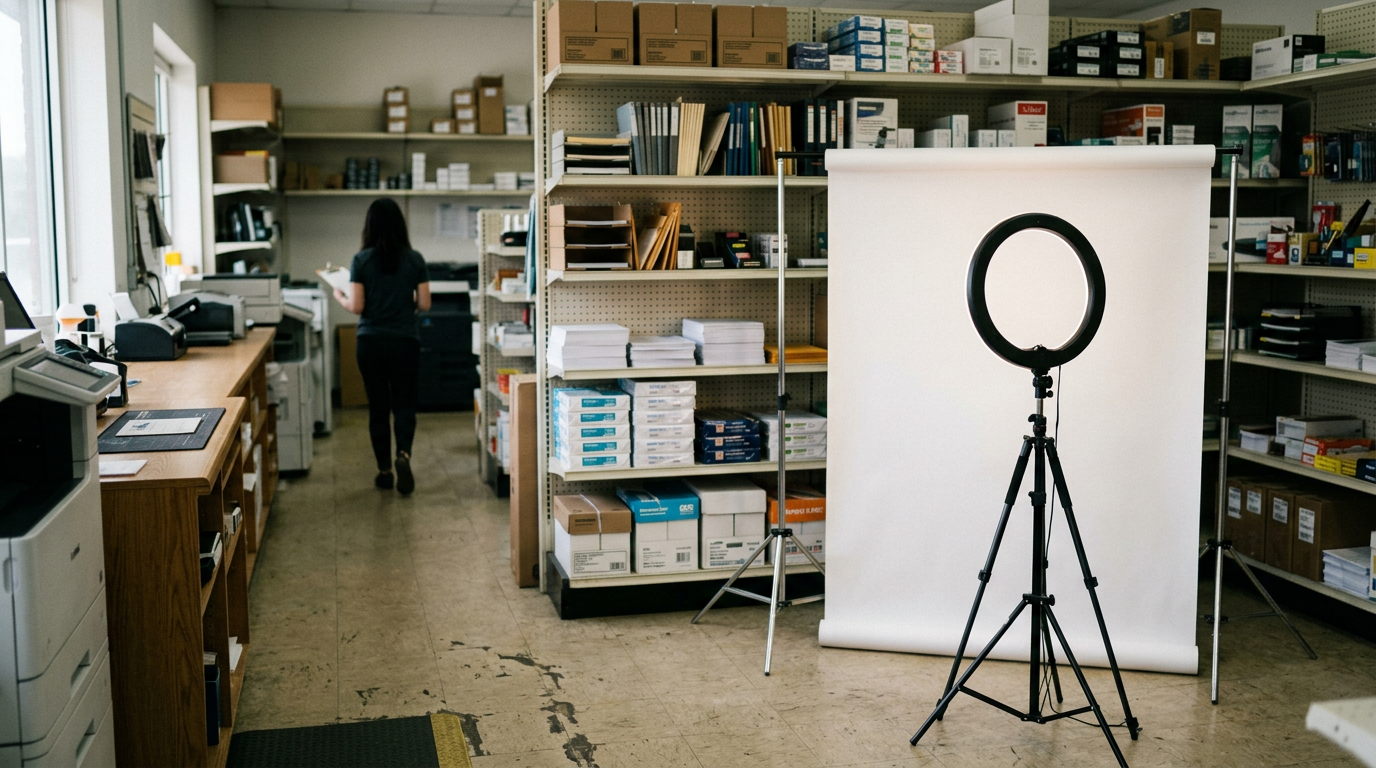
These centers utilize a designated ring light or a standing flash umbrella positioned permanently in front of a white wall. The staff input the images directly into formatting software that overlays the required oval template on the screen before printing the physical copies. For infants, staff will sometimes allow you to place the baby in their car seat covered by a white blanket, shooting downwards.
Fast printing, harsh sensory environments
The immediate turnaround time for physical prints is the primary draw here, taking only minutes once the photo is captured.
The breaking point for this option is the sensory environment. Copy centers are loud, brightly lit, and highly trafficked. The overhead warehouse lighting mixes terribly with the camera's flash, creating dual shadows behind the baby's ears that cross the background threshold. The sensory overload makes it incredibly difficult to get a newborn to look at the lens with the required neutral expression. If the baby cries, you are doing so in the middle of a busy retail floor with an audience of impatient customers waiting to use the printers.
4. Big Box Retail Photo Departments
Large department stores with dedicated photo centers represent the budget tier of the retail photography market. While parents in North America might grab a photo for a passport at Walmart during a routine shopping trip, Australian families look to similar large-format department stores with print kiosks.
The service relies on general retail staff operating a digital kiosk. The employee aims a standard digital camera, takes the photo, and plugs the SD card into a computer terminal that crops the image to a 35x45 millimeter ratio.
Budget-friendly but biometrically risky
These locations are ubiquitous and cost-effective, making them an easy stop if you are already out running errands with the baby.
Parents using these departments frequently run into employees who lack standardized training regarding infant biometric exemptions. Staff often do not know the specific nuances - such as the fact that infants under one year are generally allowed to have their mouths slightly open, provided their eyes are visible. Because they lack this training, they will frequently force parents into endless retakes trying to get a closed-mouth shot, or conversely, they will submit a photo with a parent's hand visible in the frame, leading directly to a rejection from the passport office. Understanding where to get passport photos: comparing 4 Australian service providers requires factoring in this training deficit.
5. Local Pharmacy Photo Counters
Local chemists and community pharmacies frequently double as photo printing stations, offering passport services behind the prescription counter or in a designated aisle.
The setup is usually the most rudimentary of all retail options: a white pull-down blind installed between retail shelving units. The staff member - often a pharmacy technician or a retail assistant - uses a small digital camera. There is rarely any specialized lighting; they rely entirely on the store's existing ceiling lights.
Accessible locations with inconsistent staff training
Pharmacies win on pure accessibility. You likely live within walking distance of one, which removes the stress of loading the baby into a car.
The danger here is absolute inconsistency. The quality of the photo is entirely dependent on whichever staff member happens to be on shift. You might get a photography enthusiast who understands how to bounce light, or you might get a teenager who has never attempted to photograph a moving infant.
Practical rule: If the pharmacy staff ask you to hold the baby up by the armpits against the screen, leave immediately. This posture naturally causes the baby's shoulders to bunch up around their ears, obscuring the jawline and guaranteeing a biometric failure.
6. AI-Powered Digital Platforms
Online, AI-driven passport photo services are purpose-built for parents to bypass the retail environment entirely. You capture the image at home using your own smartphone, and the software handles the complex formatting.
The mechanism removes the need for physical backdrops. Parents lay the baby down on a safe, flat surface - like a bed or the floor - facing a large window to utilize soft, natural daylight. You stand above the baby and take a photo looking straight down. When you upload the image, the computer vision algorithm automatically strips out the background (even if it was a patterned blanket), centers the face, and resizes the head to the mandatory 25-35 millimeter specification at the required 600 dpi resolution.
Complete environmental control, zero travel
The ability to photograph the baby in a familiar environment exactly when they are rested and fed drastically increases the chance of getting a compliant expression with open eyes. Looking closely at 5 best passport photo apps for fast digital compliance in 2026 shows that software now handles the heavy lifting of biometric framing.
The honest limit to this method is your own source lighting. The AI cannot invent data that isn't there. If you photograph the baby in a dark hallway using your phone's harsh flash, or under heavy yellow indoor lighting, the image grain (ISO noise) and color cast will fail the government's print quality standards. You must be willing to follow the platform's lighting instructions - specifically, shooting during daylight hours near a window - to give the algorithm a clean image to work with.
7. Automated Shopping Mall Booths
Coin-operated or card-swipe photo booths are fixtures in shopping centers and train stations worldwide, designed for quick, unassisted adult ID photos.
The booth relies on a fixed focal length camera, a harsh, timed strobe flash, and an automated software crop. The user must adjust a physical spinning stool to align their eyes with static crosshairs on a glass screen before a three-second countdown triggers the camera.
Physically incompatible with infant applicants
While these booths are efficient for adults who need a quick renewal photo on their lunch break, they are entirely unsuitable for young children.
The booth is a rigid machine that cannot adapt to an infant. There is no physical way to safely support a newborn out of the frame while aligning their face with the static crosshairs. Furthermore, you cannot time the flash. You will waste your money trying to align the baby's open eyes with a mechanical 3-2-1 countdown that you cannot pause when the baby inevitably looks away. Do not use these booths for any applicant under the age of four.
Matching the Venue to Your Baby's Mobility
Choosing the right location depends entirely on your baby's physical development and your own tolerance for logistical friction.
If your infant is over eight months old, can sit up entirely unassisted, and is unbothered by strangers in loud environments, a retail counter like Australia Post or an office supply store can process the image quickly. They have the printing infrastructure ready to go, provided the baby cooperates on the first attempt.
If your baby is a newborn with zero neck control, retail stools are a physical impossibility. You are left with two viable paths. If you have a large budget and flexible timelines, booking a professional portrait studio guarantees compliance by putting the burden of lighting and posing onto an expert. If you prefer to avoid the premium fees and the stress of aligning naps with studio appointments, shooting at home and processing through an AI platform is the pragmatic choice. When evaluating professional passport photo services vs DIY apps: how to choose in 2026, the decision usually comes down to whether you want to pay for a photographer's physical studio space or leverage software to handle the biometric formatting from your own living room.
FAQ
Can I hold my baby in the passport photo?
You may support the baby, but your hands, arms, and clothing cannot be visible in the final cropped image. The background must remain entirely plain white or light grey, which is why laying the baby down is generally safer than holding them up.
Does my newborn's mouth have to be closed?
No. The Australian Passport Office, like many international authorities, grants an exemption for infants under one year of age. Their mouths can be open, but their eyes must still be open and clearly visible.
Why was my baby's retail passport photo rejected?
The most common reasons for rejection from retail locations are shadows under the chin (caused by overhead store lighting), poor background contrast, and the baby's head tilting away from a strict vertical axis.
Can I use a pacifier to keep the baby calm during the photo?
No. Pacifiers, teething rings, and toys obscure the jawline and mouth entirely, resulting in an automatic failure of the biometric scan.